After a couple of weeks of frustration accessing blogger, I've experimented with a couple of different blog sites and finally settled for Wordpress. So from here on out I'll be posting over there. As of now, you won't find much more than a couple of videos, but I'll add more soon.
See you soon at ... http://honest2blog.wordpress.com/
Sunday, January 07, 2007


Thursday, January 04, 2007

Rick Warren on Leadership Goals
In a recent interview, Rick Warren gave the following insightful comment on church leadership.
I'm not in a hurry. I may be one of the most patient people. The biggest problem, I think, with many leaders today in the area of faith is we set goals too low and we try to accomplish them too quickly. What we need to do instead is the exact opposite. We need to let God expand our vision, our dreams and we need to take longer to do that, give our lives to do it.
Good advice.
Tuesday, January 02, 2007
My immortal

My Immortal
I'm so tired of being here
Suppressed by all my childish fears
And if you have to leave
I wish that you would just leave
'Cause your presence still lingers here
And it won't leave me alone
These wounds won't seem to heal
This pain is just too real
There's just too much that time cannot erase
When you cried I'd wipe away all of your tears
When you'd scream I'd fight away all of your fears
I held your hand through all of this years
But you still have
All of me
You used to captivate me
By your resonating life
Now I'm bound by the life you left behind
Your face it haunts
My once pleasant dreams
Your voice it chased away
All the sanity in me
These wounds won't seem to heal
This pain is just too real
There's just too much that time cannot erase
I've tried so hard to tell myself that you're gone
But though you're still with me
I've been alone all along
Who am I? (Feeling a bit introspective today)

German pastor Dietrich Bonhoeffer, who was arrested in 1943 for conspiracy against Hitler, wrote the following poem from prison to his friend:
Who am I? They often tell me
I would step from my cell’s confinement
Calmly, cheerfully, firmly.
Like a squire from his country-house.
Who am I? They often tell me
I would talk to my warders
Freely and friendly and clearly
As though it were mine to command.
Who am I? They also tell me
I would bear the days of misfortune
Equably, smilingly, proudly.
Like one accustomed to win.
Am I then really all that which other men tell of?
Or am I onlywhat I know of myself.
Restless and longing and sick, like a bird in a cage
Struggling for breath, as though hands were compressing my throat
Yearning for colours, for flowers, for the voices of birds
Thirsting for words of kindness, for neighbourliness
Trembling with anger at despotisms and petty humiliation
Tossing in expectation of great events
Powerlessly trembling for friends at an infinite distance
Weary and empty at praying, at thinking, at making
Faint, and ready to say farewell to it all?
Who am I? This or the other?
Am I one person today, and tomorrow another?
AM I both at once? A hypocrite before others
And before myself a contemptibly woebegone weakling?
Or is something within me still like a beaten army
Fleeing in disorder from victory already achieved?
Who am I? They mock me, these lonely questions of mine.
Whoever I am, thou knowest, O God, I am thine.
Who am I? They often tell me
I would step from my cell’s confinement
Calmly, cheerfully, firmly.
Like a squire from his country-house.
Who am I? They often tell me
I would talk to my warders
Freely and friendly and clearly
As though it were mine to command.
Who am I? They also tell me
I would bear the days of misfortune
Equably, smilingly, proudly.
Like one accustomed to win.
Am I then really all that which other men tell of?
Or am I onlywhat I know of myself.
Restless and longing and sick, like a bird in a cage
Struggling for breath, as though hands were compressing my throat
Yearning for colours, for flowers, for the voices of birds
Thirsting for words of kindness, for neighbourliness
Trembling with anger at despotisms and petty humiliation
Tossing in expectation of great events
Powerlessly trembling for friends at an infinite distance
Weary and empty at praying, at thinking, at making
Faint, and ready to say farewell to it all?
Who am I? This or the other?
Am I one person today, and tomorrow another?
AM I both at once? A hypocrite before others
And before myself a contemptibly woebegone weakling?
Or is something within me still like a beaten army
Fleeing in disorder from victory already achieved?
Who am I? They mock me, these lonely questions of mine.
Whoever I am, thou knowest, O God, I am thine.
Eugene Peterson writes in 'Christ Plays in 10,000 Places:
Who I am and what people think I am aren’t anywhere close to being the same thing. The better I get as a rabbi and the more my reputation grows, the more I feel like a fraud. I know so much more than I live. The longer I live, the more knowledge I acquire, the wider the gap between what I know and what I live. I’m getting worse by the day …
Seeing the same process in a more positive light, C. S. Lewis commented, ‘When a man is getting better he understands more and more clearly the evil that is still left in him. When a man is getting worse he understands his own badness less and less. A moderately bad man knows he is not very good: a thoroughly bad man thinks he is all right.’
How did my thinking end up here today? Like most things in life, it was the convergence of a number of seemingly random events: Friends withholding the truth to protect their own fragile souls, enemies withholding the truth to manipulate and control, guilt over my own role and reactions, and the resulting unanswerable questions about human nature and God. How will He unravel this tangled mess of human brokenness? What kind of father would allow his children to do these things anyway?
This Sunday I'll be preaching from Ephesians 1. Last Sunday it was Colossians 3:12-17. One of the questions that I've been wrestling with is this: what kind of man would pen these words? I know that what he wrote was inspired by God. Yet, like all preachers, writers, and teachers he 'received' these truths in the context of his own personal struggles. What kind of life and experiences must St. Paul have gone through to learn these things? As he often writes, his struggles were not merely external, but within his own soul as well.
This left me wondering. If someone were to read my sermons from the past six years, what kind of biography would they piece together concerning me? I trust that my theology primarily reflects the word of God, but no doubt it reflects my experience as well. But can God use both? He can and he does.
I think this is what we see in the life and writings of St. Paul, but also in the writings of Bonhoeffer and Lewis and even living authors such as Eugene Peterson: truth wrestled with and fleshed out in the context of suffering, betrayal, joy, worship and a host of other circumstances in which we find ourselves.
Thinking out loud …
Thursday, December 28, 2006
More Christmas pics ...
A few more Christmas pictures ...
 Christmas Party at 'The Place' - coffee shop for international students
 Christmas dinner

 Christmas Party at 'The Place' - coffee shop for international students
 Christmas dinner

Christmas dinner
Wednesday, December 27, 2006
Merry Christmas Pictures
Merry Christmas from Nicosia! We had about 40 at our Christmas lunch on Monday. Less than last year, but it was still nice to be able to provide a meal and fellowship for many who are separated from their families over the holidays. Here are some other pictures ...

Christmas Eve with the boys
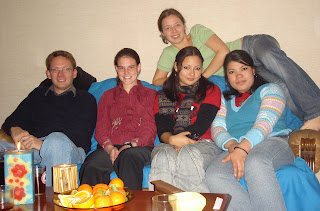
Christmas Eve party for international students

Downtown Nicosia

Climbing in the Troodos Mountains the day before Christmas (phone camera - low resolution)
Monday, December 18, 2006
Passion and Compassion
‘If you want to build a ship, don’t drum up the men to gather wood, divide the work, and give orders. Instead, teach them to yearn for the vast and endless sea.’ - Antoine de Saint Exupery
We can't 'manage' the Great Commission. We can't franchise it through the latest ministry fad. Instead we must have a passion for God and a vision for his glory that leads us to guide others in finding and following Christ. It's a vision for a kingdom that comes from outside us, but lies within us. It's a kingdom of light that conquers darkness. It's a vision that sees the glory of Light, but also feels the dispair of darkness. Our lives and ministries are then fueled by a passion for God and compassion for the lost. The best way I've found to cultivate the passion and compassion is to take a few minutes each day to pray, meditate on scripture, and bring my life back under the reign of God. And then I go out to be with my friends, coworkers, and family with spiritual eyes awake to what God is doing and wants to do in their lives. I don't think it needs to be much more complicated than that ...
We can't 'manage' the Great Commission. We can't franchise it through the latest ministry fad. Instead we must have a passion for God and a vision for his glory that leads us to guide others in finding and following Christ. It's a vision for a kingdom that comes from outside us, but lies within us. It's a kingdom of light that conquers darkness. It's a vision that sees the glory of Light, but also feels the dispair of darkness. Our lives and ministries are then fueled by a passion for God and compassion for the lost. The best way I've found to cultivate the passion and compassion is to take a few minutes each day to pray, meditate on scripture, and bring my life back under the reign of God. And then I go out to be with my friends, coworkers, and family with spiritual eyes awake to what God is doing and wants to do in their lives. I don't think it needs to be much more complicated than that ...
Monday, December 11, 2006
Worship Diversity
 A week ago Sunday we hosted our second 'Africa Worship! Night' at NIC. It was a great night of drums, dancing and praising God in a traditionally African way. Groups from the Cameroon, Nigeria, Ghana, and Zimbabwe led a multi-cultural, interdenominational congregation that filled the Anglican Cathedral.
Contrast that with our leadership retreat, which we held two days ago at an Anglican retreat center in the foothills of the Troodos mountain range. The day was led by an Anglican spiritual director who guided 16 NIC leaders through periods of silence, meditation, and Scripture reading. We finished the day with communion and a fellowship dinner.
While NIC leadership was responsible for both events, they couldn't have been more different. One was loud, the other quiet. One was big, the other small. And yet God spoke in both. The diversity has been a great way for us to grow spiritually, and it is one of the things I love about this church. It isn't an easy church to be a part of precisely because worshiping with such diversity requires work, but I think it's important.
In some sense, NIC is a revelation of the mystery Paul wrote of in Ephesians 3:6 -
This mystery is that through the gospel the Gentiles are heirs together with Israel, members together of one body, and sharers together in the promise in Christ Jesus.
This type of unity in diversity is also a powerful witness to the world and an answer to Jesus' prayer found in John 17:23 -
May they be brought to complete unity to let the world know that you sent me and have loved them even as you have loved me.
Unfortunately, I don't have pictures of the Africa Worship! Night, but I do have one from the leadership retreat. The countries represented were Zimbabwe, Sri Lanka, England, Ghana, Lebanon, the Cameroon, United States, Cyprus, Latvia, and Nigeria.
Thursday, December 07, 2006
More on St. George

Most of the eastern icons of St. George depict him with a little guy sitting on the back of the horse. I've asked priests and monks who he is, but no one ever seems to know. But DeAnn Hertzog did some reading and here's what she discovered:
I did some research about the guy sitting behind St. George in Eastern Orthodox icons. I googled him and asked someone. That didn't give me any answers so I got a book from the library. Here's what it said:
"The most intriguing of these additional figures is a young boy whom we sometimes find perched on the crupper on George's charger. He is a specialty of eastern European art from quite on early period. We cannot be at all sure, however, whom this mysterious little figure is meant to represent. He may be George's servant, his 'coffee boy', as Osbert Lancaster calls him, perhaps even Pasicrates himself. But there have been a number of other interpretations. George Every, for example calls him 'a figure of Christ'. He has also been described as 'a young Paphlagonian rescued by St George when he was being carried away into slavery'. There seems to be no knowing. All we can really say is that for Byzantine painters the boy evidently provided an oppurtunity for introducing a lighter touch, almost an element of comic relief, into a subject which was otherwise so highly charged with emotion."
The book is called "Saint George:the saint with three faces" by David Scott Fox.
If you know who Pasicrates is let me know. From what I can find there were a few. It could be refering to the man who wrote down the story of George and claimed to be a contemporary of his, but actually lived much later. I don't know if this is the same Pasicrates who was a martyr from Cyprus.
I don't know who Pasicrates is. Any ideas?
Sunday, December 03, 2006
Discipleship and Discipline

The root of the word discipline is disciple. You can’t be a disciple – or make disciples – without discipline. Engaging in spiritual disciplines creates an atmosphere in the heart where the Spirit of God gives birth to the fruit of the Spirit. It is through spiritual disciplines that we become strong in our spirits and learn to live by the Spirit (1 Corinthians 9:27). Spiritual disciplines include systematic Bible study, meditation, scripture memorization, disciplined prayer, fasting, rest, etc.
Sometimes we equate effort with works or the flesh. I’ve been influenced once again by Dallas Willard in this regard, but he says that while we cannot earn grace, that doesn’t mean it doesn’t take effort. By taking the time away from our regular ministry activity to practice spiritual disciplines we are demonstrating our faith in God. Spiritual disciplines and intentional discipleship may be the primary way we show that we are ministering by faith in the power of the Spirit because there isn’t always an immediate, tangible result. We wouldn’t take the time to memorize scripture or take a Sabbath rest unless we believed that what God does is more important than all the stuff we are able to do for Him. We want more of God and less of us. But it takes work to stop working in order to let God work! That’s where spiritual disciplines help us.
But just as discipline is essential to our own personal life of discipleship, discipline is also necessary if we are to make disciples. Making disciples doesn’t just happen. We need a plan (a strategy), and then we need to be disciplined to stick to the plan. Being disciplined means not only having a ‘to do’ list, but having a ‘not to do’ list as well. Are there things that you’re going to have to stop doing in order to make time for the discipling God has called you to do?
The energizing of the Holy Spirit, the guidance and teaching of the Scriptures, the will to be obedient, and a plan. These are the ingredients for a disciplined – and fruitful – life. What spiritual disciplines can you practice more deliberately this week?
We put up our Christmas tree this week ...

Tuesday, November 28, 2006
Thanksgiving Turkey and Christ the King Sunday
For all those who were wondering, yes, the turkey was fine. Actually, the turkey was dead - but it cooked up fine! It even looked like a Thanksgiving turkey! I was quite proud of myself considering I had never even cooked a chicken before.
This past Sunday was Christ the King Sunday according to the church calendar. The lectionary reading was the account of Jesus before Pilate found in John 18. It seemed a bit strange to be preaching from a text associated more with Holy Week, yet Jesus' comments about his kingdom not being of this world made it appropriate. The passage is a visual picture of two kingdoms coming face to face with each other - one kingdom represented by Pilate and the other by Jesus. I think Jesus gives us a clear picture of how we are to respond to evil people and evil systems. What he taught in Matthew 5 he lived in the closing pages of John.
At least twice the people tried to make Jesus their political messiah or king (John 6 and 12). In both cases it says that Jesus withdrew and hid himself. Apparantly he felt that there was a better way to deal with evil than occupying positions of power. I think that's what he calls the Church to as well. The Church - and only the Church - can confront evil the way Jesus did. He stopped the cycle of evil not by punishing it, but by forgiving it. When we punish we put the consequences of someone's sin back on them. When we forgive we let the consequences of their sin rest on us. This is why it is harder to forgive than to punish.
As I pictured Jesus standing silent before Pilate I was reminded of Paul's words in Ephesians 6:13 -
Therefore take up the whole armor of God, that you may be able to withstand in the evil day, and having done all, to stand.
That is what Jesus did. He did not conquer ('My kingdom is not of this world') and he did not resist. He stood. And three days later he demonstrated that the way of mercy, grace and forgiveness is the way of victory. In fact, it is the only way that death and all the related evil could finally be destroyed.
Where is the church that is willing to live by the Sermon on the Mount? Where is the church that has the courage to proactively confront the evil of the world by inviting the world to live under the reign of God? Where is the church that, having done all, will stand?
Next Sunday is the first Sunday of Advent. The reading will be taken from Luke 21 where Jesus' speaks about his future return. I find it facinating that the Christian calendar begins not with the first coming of Jesus, but with his second coming! The call is to watch and pray. More about that next week ...
Wednesday, November 22, 2006
Happy Thanksgiving
I just wrote a post that got lost in cyberspace, but I'm not going to try to recreate it. However, I can still paste the Dallas Willard quote here:
‘I do not know of a denomination or local church in existence that has as its goal to teach its people to do everything Jesus said. I’m not talking about a whim or a wish, but a plan. I ask you sincerely, is this on your agenda?’
I could honestly tell Dr. Willard that those who just completed the Keystone Project have vision statements and specific strategies to do just this!
Tomorrow is Thanksgiving in America and so I will be trying to cook a turkey for the first time!
Tuesday, November 14, 2006
Made it to Ft. Wayne
Arrived in Ft. Wayne Saturday night from Rapid City (via Minneapolis and Detroit). It was great to see my mom, sister, brother and nephew at the airport! Sunday morning spoke in a Sunday School class at First Missionary Church and had a good conversation about persecuation and, of course, discipleship. Then my family all went for Japanese food to celebrate my birthday! Today has been a busy one as I finished shopping for Cyprus and spent the evening with the Hertzog's talking about Cyprus. They should be joining me in Cyprus the beginning of 2007.
Tomorrow will be a slow day of relaxing before I return to Cyprus on Wednesday. Fortunatly, I don't have to preach on Sunday! I can't wait to see my kids ...
Tomorrow will be a slow day of relaxing before I return to Cyprus on Wednesday. Fortunatly, I don't have to preach on Sunday! I can't wait to see my kids ...
Saturday, November 11, 2006
Graduation!


Today we celebrated the completion of the Keystone Project - Fall 2006. 23 leaders from Africa, Asia, Europe and North America have completed the training and prepared strategies to facilitate disciple-making movements in their home countries. It's been a great month and the visions that God has birthed in the hearts of these men and women are incredible. Now the fun starts as we go back to places like Uganda, India, the United Kingdom, Cyprus, Egypt, Togo and Texas to start making disciples.
It's hard to say goodbye after spending a whole month living in a multicultural community of men and women passionate about the Great Commission, but we are eager to get back to our families and ministries. I'll be stopping off in Fort Wayne to say hello to family and friends before heading back to Cyprus next Wednesday.
You can see a picture of the team I coached further down on the blog (focusing on England, Cyprus and the Middle East), but here are pictures of all the coaches and me with the president of the Four Square churches of the Ivory Coast and the Bishop of the Methodist Church of Togo.
Thanks for your prayers!
Friday, November 10, 2006
Something's wrong ... Part 3
Here are some interesting quotes from 'The Politics of Jesus,' chapter 8 - Christ and Power, that relate to the whole issue of how the church confronts evil. This is a timely message for the church in an age where we feel increasingly marginalized and powerless to do things about moral evil in the world. I believe Yoder provides us with a positive and powerful alternative to the individualism and quest for power and influence that currently dominates North American Christianity. When Yoder refers to 'Powers' in the following quotes, he means structural powers created to control or influence. These can be political, economic, religious or cultural structures or systems. While the Bible credits God as the creator of these powers (and therefore they are good), they are currently fallen and under the influence of the Evil One.
'The creature and the world are fallen, and in this the powers have their own share. They are no longer active only as mediators of the saving creative purpose of God; now we find them seeking to separate us from the love of God (Romans 8:38). These structures which were supposed to be our servants have become our masters and guardians.'
'To what are we subject? Precisely to those values and structures which are necessary to life and society, but which have claimed the status of idols and have succeeded in making us serve them as if they were of absolute value.'
Quoting Berkhof, 'All resistence and every attack against the gods of this age will be unfruitful, unless the church itself is resistance and attack, unless it demonstrates in its own life and fellowship how believers can live freed from the Powers. We can only preach the manifold wisdom of God to Mammon if our life displays that we are joyfully freed from his clutches. To reject nationalism we must begin by no longer recognizing in our own bosoms any difference between peoples. '
'The church does not attack the powers; this Christ has done. The church concentrates upon not being seduced by them. By existing the church demonstrates that their rebellion has been vanquished.'
And quoting Oldham, 'If our diagnosis is true, the world cannot be set right from the top but only from the bottom upwards.'
'The primary structure through which the gospel works to change other structures is that of the Christian community.'
To sum up Yoder, the Church confronts the powers of the world by standing as a community that refuses to be seduced by them. The cross of Christ stands in judgment of the powers and structures of the world, and the Church - the community of people shaped by the cross - stand as living testimony and witness to the victory and reign of Christ. This is why ultimately the contribution that Christians make is not by being culturally relevant or politically strong. It is by living a life of discipleship - as apprentices of Jesus, allowing Him to create a new community by his grace, Spirit and call to follow Him. Once again, it is practical discipleship that makes the Church a unique and divine institution in the world, and this is why Jesus commands us to go into all the world and make disciples.
Monday, November 06, 2006
Bonfire of the Vanities - for Ted Haggard
Sherman McCoy, the leading character in Tom Wolf’s bestselling novel The Bonfire of the Vanities, is a prisoner of the Wall Street world where he makes millions of dollars as a high profile bonds broker. His ‘lifestyle of the rich and famous’ collides with the life of the sleazy and desperate in the New York City justice system when he accidentally runs over a young, black youth while returning from the airport with his mistress. As the story unfolds, multiple characters find their lives dictated by the larger stories in which they live: journalists sell their souls for a headline, real estate brokers for a sale, attorneys for a fee or favor, and drug dealers for a reduced sentence. For nearly 700 pages we are exposed to the lives of people who are trying to navigate systems that appear out to destroy them, all the while seeking to stimulate (or medicate) their lives by having affairs, making obscene amounts of money, displaying their male machismo or female sensuality, climbing the power structures, or flaunting their fame. It doesn’t seem to matter whether one is at the top of the social circle or low-life street scum. Everyone is a prisoner of their environment. Everyone is hiding who they really are.
McCoy thinks he is losing control of his life as a local tabloid exploits his misery by publishing details of his affairs, his wealth, and his negligence at leaving the scene of an accident in an impoverished neighborhood of the Bronx. Local politicians seem less concerned with justice than they are with placating the racial tensions in order to protect their political ambitions. McCoy himself is desperate to keep his income, his image, and his family in tact. As everything around him collapses, he discovers that he had been a prisoner to all these forces. After a year of navigating the judicial system, reporters questioned McCoy about the contrast between his Park Avenue life and surviving the political and legal nightmare of the Bronx. McCoy responds, ‘I have nothing to do with Wall Street or Park Avenue.’ Ironically, as the world he knew collapsed around him, he found liberation and his true self. The old Sherman McCoy died, and a new one – not a nice, pretty McCoy, but a McCoy who could live with himself – was born. Though he is the one most likely going to jail, he also becomes the one most at peace with his life. At some level, McCoy rose above the controlling narratives of his social obligations, business demands, and the complex political and judicial systems of New York City. He was freed.
In similar fashion, the evangelical church in America is facing a crisis of identity. As we seek to defend our way of life, our cultural values and our influence in society we are finding things fall apart around us. 500 billion dollars has been spent on domestic ministries over the past decade, yet less people are involved in the institutional church than before. Political and religious leaders attempt to rally the troops be scaring us with threats of moral decay, liberal legislation and dying churches. But Jesus said, ‘I will build my church and the gates of hell will not prevail against it.’ We are commanded to make disciples. He will build the church. I believe that crisis in the western church is that we have the roles reversed. We are trying to build big, strong, relevant churches and hoping that people will somehow get discipled in the process. I suggest that if we focused on planting churches by making disciples rather than planting churches in order to make disciples we might discover once again what it means to live with God and to be the people of God.
Sunday, November 05, 2006
Leading with the Word of God ... Part 2

It's a beautiful day in Keystone, South Dakota. Most of the people have gone to the state park to look at buffalo, but I stayed back to get some rest and do some reading. While reviewing 'The Missional Leader: Equipping Your Church to Reach a Changing World' I came across the following quote concerning the type of leadership the author's believe is necessary to navigate our rapidly changing world. Notice the return to the traditional roles of spiritual leadership ...
Beginning with a quote from Stanley Haeurwas (After Christendom?) they write,
'" We are not Christians because of what we believe, but because we have beenPS - The picture was taken of a coaching session. Pray for this team as we finish ministry strategies this week for Cyprus, England and the Middle East.
called to be disciples of Jesus. To become a disciple is not a matter of a
new or changed self-understanding, but rather to become part of a different
community with a different set of practices ...' Such formation calls for
leaders who themselves have been apprenteiced in the art of formation in the
alternative society of God. These leaders are in short supply within
Protestant North America. Instead, we see a rising demand for the leader as
entrepreneur (to make things happen and drive for success), diagnostician of
health (the church as doctor or therapist), or grower of homogenious gatherings
(forming gated communities in anxious suburban worlds). There is a dearth
of those schooled in the practices of catechesis, confession, hospitality to the
stanger, forgiveness and shaping life as a Eucharistic community.' (page
123)
Pictures

For some reason I couldn't post this with the other entry.
This is me with Dr. Dobson. He's the one standing at the podium. :-)
Of course, I had to take the 'tourist' picture as well!
In the last picture you can see that the National Parks Service kindly reminded us that they had nothing to do with this rally!


Subscribe to:
Posts (Atom)
